

A roll slitter rewinder is an essential piece of equipment in various industries, especially those dealing with flexible materials such as paper, film, foil, and non - woven fabrics. As a supplier of roll slitter rewinders, I am often asked about the working principle of these machines. In this blog post, I will delve into the details of how a roll slitter rewinder operates, providing a comprehensive understanding for both industry professionals and those new to the technology.
Overall Working Process
The roll slitter rewinder's primary function is to take a large master roll of material and slit it into multiple narrower rolls, which are then rewound onto separate cores. The entire process can be divided into three main stages: unwinding, slitting, and rewinding.
Unwinding
The first stage of the process is unwinding. The master roll of material is loaded onto an unwinding shaft or spindle. This shaft is typically driven by a motor, which rotates at a controlled speed to feed the material into the slitting section. To ensure a smooth and consistent unwinding process, tension control is crucial. Tension control systems use sensors to monitor the tension of the material as it is unwound. If the tension is too high, the material may break; if it is too low, the material may wrinkle or become misaligned.

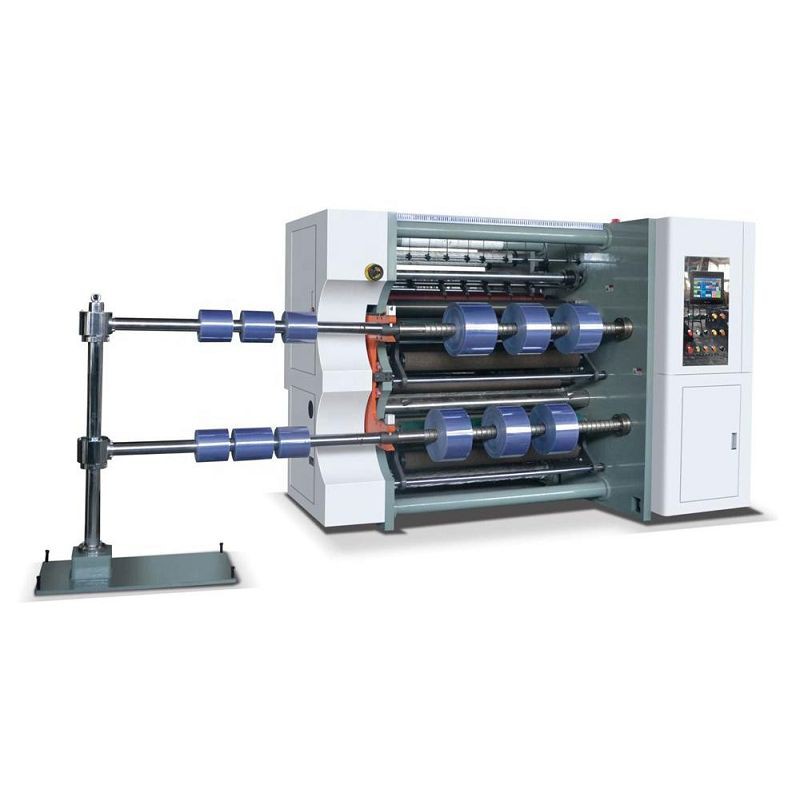
There are different types of tension control methods, such as friction brakes, pneumatic brakes, and servo - controlled drives. Friction brakes are the simplest and most cost - effective option, but they may not provide the most precise control. Pneumatic brakes offer better control and are suitable for a wide range of materials. Servo - controlled drives provide the highest level of precision and are often used in high - end roll slitter rewinders.
Slitting
Once the material is unwound, it enters the slitting section. The slitting process involves cutting the wide material into multiple narrower strips. There are several slitting methods, each with its own advantages and applications.
- Rotary Shear Slitting: In rotary shear slitting, two circular blades rotate against each other, similar to a pair of scissors. This method is suitable for slitting thin and flexible materials such as paper, film, and foil. The blades can be adjusted to achieve different slit widths, and the cutting action is smooth, resulting in clean edges.
- Score Slitting: Score slitting uses a single blade that presses against a hard anvil to cut the material. This method is commonly used for slitting thicker materials such as cardboard and some non - woven fabrics. Score slitting is relatively simple and cost - effective, but it may not provide as clean an edge as rotary shear slitting.
- Crush Slitting: Crush slitting involves using a circular blade that is forced through the material, crushing it as it cuts. This method is suitable for slitting materials that are difficult to cut using other methods, such as some types of foam and rubber.
The slitting blades are mounted on a slitting shaft or a slitting head, which can be adjusted to position the blades at the desired locations. The accuracy of the blade positioning is critical to ensure that the slit widths are consistent.
Rewinding
After the material is slit, the individual strips are rewound onto separate cores. The rewinding process is similar to the unwinding process in terms of tension control. The tension of each rewound roll needs to be carefully controlled to ensure that the rolls are wound tightly and evenly.
The rewinding shafts are driven by motors, and the speed of each shaft can be independently controlled. This allows for different rewinding speeds for each strip, which is necessary when slitting materials with different thicknesses or properties. In addition, the rewinding process may also involve edge guiding systems to ensure that the strips are wound straight onto the cores.
Key Components of a Roll Slitter Rewinder
- Unwinding Unit: As mentioned earlier, the unwinding unit is responsible for holding and feeding the master roll. It includes the unwinding shaft, tension control system, and sometimes an edge guiding system.
- Slitting Unit: The slitting unit consists of the slitting blades, blade mounting system, and a mechanism for adjusting the blade positions. Some advanced slitting units also have automatic blade sharpening systems to maintain the cutting performance.
- Rewinding Unit: The rewinding unit is responsible for winding the slit strips onto the cores. It includes the rewinding shafts, tension control system, and edge guiding system.
- Control System: The control system is the brain of the roll slitter rewinder. It coordinates the operation of all the components, including the motors, sensors, and actuators. Modern control systems are often based on programmable logic controllers (PLCs) and touch - screen interfaces, which allow for easy operation and monitoring of the machine.
Applications of Roll Slitter Rewinders
Roll slitter rewinders are widely used in various industries, including:
- Packaging Industry: In the packaging industry, roll slitter rewinders are used to slit and rewind materials such as paper, film, and foil for packaging applications. For example, they can be used to produce labels, flexible packaging, and carton liners.
- Printing Industry: In the printing industry, roll slitter rewinders are used to prepare materials for printing presses. They can slit large rolls of paper or film into the appropriate widths for printing, and then rewind the printed materials into rolls for further processing.
- Textile Industry: In the textile industry, roll slitter rewinders are used to slit and rewind fabrics, non - woven materials, and tapes. They can be used to produce narrow strips of fabric for clothing, home textiles, and industrial applications.
Advantages of Our Roll Slitter Rewinders
As a supplier of roll slitter rewinders, we offer several advantages to our customers. Our machines are designed with the latest technology and high - quality components, ensuring reliable performance and long - term durability. We also provide customized solutions to meet the specific needs of our customers. Whether you need a machine for slitting thin films or thick cardboard, we can design and manufacture a roll slitter rewinder that is tailored to your requirements.
In addition, our roll slitter rewinders are easy to operate and maintain. We provide comprehensive training and technical support to our customers, ensuring that they can operate the machines efficiently and troubleshoot any issues that may arise.
If you are interested in learning more about our Slitting and Rewinding Machine, Automatic Slitting Machine, or the Slitting and Rewinding process in general, please feel free to contact us. We are always ready to discuss your needs and provide you with the best solutions for your business.
References
- "Handbook of Flexible Packaging Technology" by Wilmer A. Jenkins and James P. Harrington
- "Slitting and Rewinding Technology" by the Association of International Metallizers, Coaters and Laminators (AIMCAL)
- Industry whitepapers on roll slitter rewinder technology from leading manufacturers.


