


In modern industrial production, paper roll slitting machine is a key equipment for paper processing, and its performance is directly related to the quality and production efficiency of the product. The tension control system, as the core component of the paper roll slitting machine, is the key to ensure the stable and efficient operation of the slitting process. This article will comprehensively explain the tension control system of the paper roll slitting machine, from its main components, working principles, functions, adjustment optimization to common fault handling, to provide readers with a detailed guide.
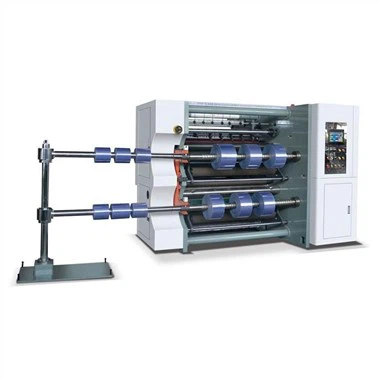
Main components of the tension control system of the paper roll slitting machine
The tension control system of the paper roll slitting machine is mainly composed of the sensor part, the controller part, the actuator part and the auxiliary parts.
1. Sensor part: The tension sensor is the "eye" of the system, responsible for real-time detection of the tension of the paper roll. It is usually installed at the key position of the paper roll, such as unwinding and rewinding, and converts the tension into an electrical signal by physical or chemical means for subsequent processing. Common tension sensors include strain gauge type, magnetoelectric type, etc., and their selection needs to be determined according to the specific application scenario and accuracy requirements.
2. Controller part: The controller is the "brain" of the system, responsible for receiving signals from the sensor and performing calculations and processing according to the preset control algorithm. It sends instructions to the actuator based on the processing results to adjust the tension of the paper roll. The controller usually uses an advanced microprocessor or PLC (programmable logic controller) with powerful data processing capabilities and flexible programming interfaces.
3. Actuator part: The actuator is the "hands and feet" of the system, responsible for responding to the controller's instructions and adjusting the tension of the paper roll. Common actuators include brakes, clutches, servo motors, etc., which adjust the tension by changing the speed and tightness of the paper roll. The performance and response speed of the actuator directly affect the accuracy and stability of the tension control.
4. Auxiliary components: including power supply, signal lines, interfaces, etc., which provide necessary support and guarantee for the normal operation of the system. Although these components seem inconspicuous in the system, their stability and reliability are equally important.
Working principle of the tension control system of the paper roll slitting machine
The working principle of the tension control system of the paper roll slitting machine mainly includes four links: tension detection, signal processing, control output and feedback mechanism.
1. Tension detection: The sensor detects the tension of the paper roll in real time and converts it into an electrical signal. This signal usually contains information such as the size and direction of the tension, which is the basis for subsequent processing.
2. Signal processing: The controller receives the signal from the sensor and performs filtering, amplification, conversion and other processing to extract useful tension information. At the same time, the controller will also calculate according to the preset control algorithm and parameters to obtain the tension value that needs to be adjusted.
3. Control output: The controller sends an instruction to the actuator based on the processing results, requiring it to adjust the tension of the paper roll. This instruction is usually transmitted through an electrical signal or a pneumatic signal, and the actuator will respond immediately after receiving the instruction.
4. Feedback mechanism: The system achieves precise control of tension through a closed-loop feedback mechanism. That is, after the actuator adjusts the tension, the sensor will detect the tension of the paper roll again and feed the result back to the controller. The controller further adjusts the instruction based on the feedback result to form a closed-loop control loop. This mechanism can ensure the control accuracy and stability of the tension.
What role does the tension control system play in the paper roll slitting process?
The tension control system of the paper roll slitting machine plays a vital role in the slitting process. It can not only ensure the slitting quality and improve production efficiency, but also protect the equipment from damage.
1. Ensure slitting quality: Tension is an important factor affecting slitting accuracy and trimming flatness. By accurately controlling the tension of the paper roll, the paper size after slitting can be ensured to be accurate and the edges are flat, thereby improving the overall quality of the product.
2. Improve production efficiency: Tension control can reduce the scrap rate and increase production speed. When the tension is unstable, it is easy to cause problems such as paper breakage and wrinkles, which affects production efficiency and product quality. The tension control system can adjust the tension in real time to avoid these problems and improve production efficiency.
3. Protect equipment: Tension control is also crucial to the protection of equipment. When the tension is too large, it is easy to cause equipment overload and damage; when the tension is too small, it may cause problems such as paper loosening and winding. The tension control system can ensure that the tension fluctuates within a reasonable range, thereby protecting the equipment from damage.
How to adjust and optimize the tension control system of the paper roll slitting machine to improve slitting efficiency
In order to improve the slitting efficiency of the paper roll slitting machine, we need to adjust and optimize the tension control system. Here are some effective methods:
1. Parameter setting: According to the material, thickness and other parameters of the paper roll, reasonably set the parameters of the tension control system. These parameters include tension setting value, control algorithm parameters, etc. Their settings directly affect the control effect of tension. Therefore, we need to adjust and optimize according to the actual situation to ensure the stability and accuracy of tension.
2. System calibration: Regularly calibrate the tension control system to ensure the accuracy of tension measurement. The calibration process includes sensor calibration, controller calibration, etc. Calibration can eliminate system errors and improve measurement accuracy.
3. Optimization strategy: Use advanced control algorithms and optimization strategies to improve the stability and response speed of tension control. For example, PID control algorithms, adaptive control algorithms, etc. can be used. These algorithms can be dynamically adjusted according to actual conditions to ensure accurate control of tension.
4. Monitoring and maintenance: Strengthen the monitoring and maintenance of the tension control system. Regularly check the sensitivity of the sensor, the operating status of the controller, etc., and promptly discover and deal with potential problems. At the same time, perform regular maintenance and cleaning of the system to ensure long-term stable operation of the system.
Common faults and solutions of the tension control system of the paper roll slitting machine
During the operation of the tension control system of the paper roll slitting machine, some common faults may be encountered. The following is a summary of these faults and their solutions:
1. Sensor failure: The sensor may fail due to aging, damage or improper installation. It manifests as inaccurate tension measurement, large signal fluctuations, etc. The solution is to replace a new sensor or adjust the installation position of the sensor to ensure its normal operation.
2. Controller failure: The controller may not work properly due to program errors, hardware damage or interface failures. It manifests as failure to receive sensor signals, failure to issue control instructions, etc. The solution is to repair the controller or replace it with a new one, and reprogram or configure parameters.
3. Actuator failure: The actuator may fail to respond to the controller's instructions due to wear, jamming or damage. It manifests as the inability to adjust the paper roll tension or inaccurate adjustment. The solution is to repair the actuator or replace it with a new one, and check its connection with the controller.
4. Systematic failure: Systematic failure may be caused by communication failure, power failure, etc. It manifests as the system failing to operate normally or unstable operation. The solution is to check the system's communication lines, power lines, etc. to ensure that the connection is correct, stable and reliable. At the same time, conduct a comprehensive inspection and test of the system to find out the fault point and repair it.


