

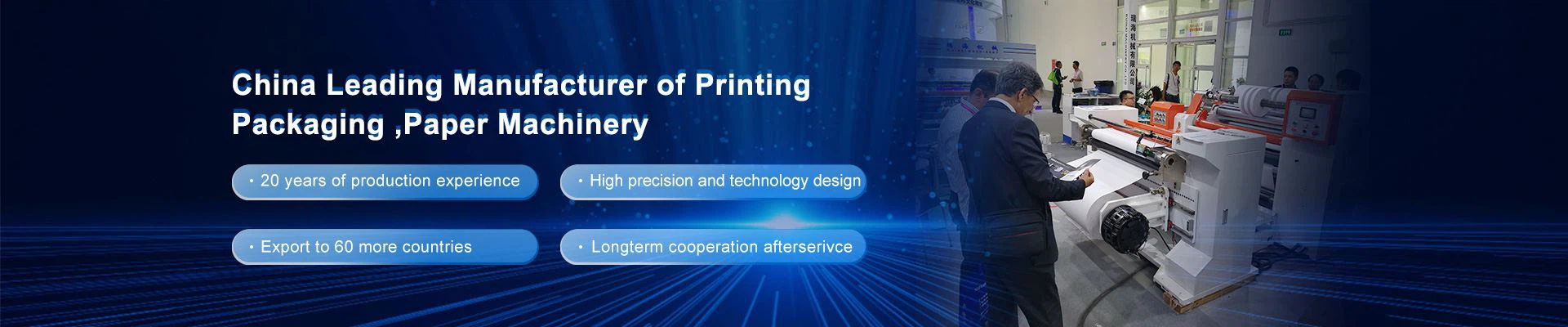
In label printing, packaging material processing, etc., paper sticker slitting machines is core equipment of post-printing processing. For small production scenarios, enterprises need to balance equipment accuracy and flexibility while controlling procurement costs and maintenance complexity. Based on the core parameters, functional adaptability and cost optimization, this paper will systematically expound the selection strategy of paper ripping machine for small batch production based on the latest technological development trend and typical application cases.
Precise Matching of Core Performance Parameters
1.Balancing Slitting Speed and stability
Small batch production is characterized by frequent changes in order specifications and short production cycles. Therefore, the speed of equipment should follow the principle of ``appropriate but not excessive ''. Take the HS-350 slitting machine of Zhejiang Haoda Machinery as an example. Its maximum speed is set at 350 metres per minute, but in practice, when 80g of 80-gram paper stickers are shredded, steady speeds are maintained at 220-250 metres per minute. This not only guarantees the processing of 1.2-1.5 tons of raw materials per hour, but also avoids tension fluctuations caused by excessive pursuit of speed. Equipment selection is recommended based on material characteristics: for film materials, you can choose models with a speed limit of more than 300 m/ min, and for cardboard materials (such as cardboard with a speed of more than 200 g), you can choose models with a speed limit of more than 200 m/ min.
2.Hierarchical Configuration of Tension Control Systems
Tension control is the core technology of paper sticker slitting, which directly affects the neatness of winding and material utilization. For small batch production, a "Basic Automatic Tension + optional full-servo" configuration is recommended:
Basic automatic tension: The tension fluctuation range of ±0.5N can be achieved by magnetic powder clutches and PLC closed-loop control. Guangdong Wanlian Precision Machinery, for example, the WL-F series equipment, in the cutting of 50-150 grams of adhesive paper, can be kept to 1.2% waste rate.
Full-Servo Tension System: For high-precision scenarios such as electronic labeling and drug packaging, a tension control system driven by a dual servo motor is required. The TZ-F600 model tensile deformation machine produced by Jiangyin Tongze Technology can control the tension of the tensile, traction and rewinding links independently, so that the tensile deformation rate of the material is less than 0.3% and achieves accuracy ± 0.2 N.
3. Selection of sectional Precision and blade type
Indry-adhesive paper slitting accuracy includes two aspects:
- Width Precision: Width accuracy ±0.3mm for ordinary label production and ± 0.1 mm for precision electronic label production. It is recommended to choose equipment with high precision linear guides (such as the HIWIN series) and ball screws. For example, the KQ-F450 model from Wenzhou Keqiang Machinery ensures long-term accuracy and stability by using CNC-machined blade holder bases.
- Blade Type Adaptation: circular blade is suitable for thin film material, while straight blade is more suitable for cardboard material. For composite adhesive paper materials, it is recommended to adopt the combination of ``blade + bottom roller ''. The XC-F320 model of Shandong Xinchuan Machinery can effectively solve the bonding problem by means of adjustable pressure razor blade device.
Flexible Combination of Functional Modules
1. Gradient Configuration of Levels of automation
The demand for automation of equipment in small-scale production is polarized:
Basic automation: with automatic meter counting, pneumatic material loading, manual knife changing and other functions, suitable for workshop production of less than 5 tons per day. For example, the SG-F200 model of Xingtai Shuangguan Machinery allows users to add photoelectric correction or electrostatic elimination modules to their budget through modular design.
Intelligent automation: integrated with automatic rewinding, on-line monitoring of blades and traceability of production data, it is suitable for flexible production of multiple varieties and small batches. Jiang Jiangyin Tongze Technology The TZ-F600 model can monitor the quality of a cut in real time through industrial cameras and artificial intelligence algorithms, automatically stopping and alerting when the cut edge rate exceeds a set value.
2. Adaptability of Unwinding and Rewinding Structures
According to the specification requirements of raw material roller and finished product roller, the following aspects need to be focused on:
Roll Diameter: It's best to choose a model with a a maximum unwinding diameter of 800-100mm, which will not only accommodate traditional 500-600mm raw material rolls, but also reduce the frequency of roll changes. The the JS-F500 model, for example, is designed to carry 1.2 tons of raw material rolls via a reinforced pneumatic shaft design.
Rewinding method: For small batch production, dual-station rewinding is 40% more efficient than single-station rewinding. Dongguan Zhenfei Machinery ZF-F300 adopts servo motor to drive differential shaft winding, which can control the tension error of finished product rolls in different positions to ±5%.
3. Necessity of Correction Systems
Indry-adhesive label materials are prone to transverse bias during sectioning and therefore need to be equipped with photoelectric or ultrasonic correction devices. Models with correction precision ± 0.5mm and response time of 0.02 seconds are recommended. For example, the GB-F400 model of Zhejiang Gaobao Machinery can effectively solve the problem of edge inhomogeneity caused by material bias by combining E+P correction sensor and stepper motor linkage.
Optimizing the cost of Total life cycle
1. Gradient Control of Procurement Costs
Depending on the size of the production, the budget can be divided into three segments:
Economy ($80,000-$150,000): Suitable for start-ups or contract manufacturing workshops. Choosing basic model of domestic second-line brand, such as Hebei Xingtai, Shuangguan, Zhengshun and other manufacturers' products. Simple configuration but low maintenance.
Mid-range model (150,000-300,000 yuan): Ruian Jiansheng, Dongguan Zhenfei and other Zhejiang, Guangdong brands Recommended equipment. Equipped with automatic tension control and basic correction functions, can meet 80% of regular order requirements.
High-end type (more than 300,000 yuan): medicine, electronics and other special areas, the need for Jiangyin Tongze, Zhejiang Haoda and other production enterprises equipment. Their full-servo control systems and custom-designed blade holder can improve material efficiency by 2-3 percentage points.
2. Energy Consumption and Maintenance Costs
Power System Selection: Servo motor drives than traditional frequency converter motor drive energy saving 15 -20%. Guangdong Wanlian Precision Machinery's WL-F series, for example, uses energy feedback technology to reduce backup power consumption to less than 0.5 kW.
Consumption service life: focus on blade, magnetic powder clutches and other components replacement cycle. High-quality blades can slit continuously for between 500,000 and 800,000 metres, while low-end products can only be used for between 200,000 and 300,000 metres. It is recommended that manufacturers such as Jiangyin Tongze Technology, which promises to reduce the cost of core components by 30% over their useful life, choose to guarantee the supply of original spare parts.
3. Assessment of After-Sales Service Systems
Smaller batches are less tolerant of equipment downtime, so focus on the following:
Response time: Prioritize manufacturers with local service outlets. Zhejiang Shenda Machinery, for example, has 23 after-sales service centers across the country that provide 24-hour fault response.
Training support: require operator training and process guidance services from manufacturers. Dongguan Qiguang Machinery, for example, assigns a professional process engineer to each piece of equipment to assist customers optimize slitting parameters.
Upgrade potential: Choose devices that support modular upgrades. For example, Wenzhou Senchuang Machinery 'SC-F series of models allows users to gradually add modules such as automatic rewinding and online inspection in line with business development.
Prospects for Future Technological Trends
With the advancement of Industry 4.0, three major trends in the development of Industry 4.0, development trends sticker slitting machines are as follows:
- Intelligent upgrade: through the equipment industry Internet module, realize remote equipment status monitoring and predictive maintenance. Jiangyin Tongze Technology, for example, is developing the TZ-iF series equipment that can predict critical component failures 48 hours in advance.
- Green manufacturing: Energy feedback technology and lightweight design reduce equipment energy consumption by more than 25%. For example, the next-generation WL-F series models produced by Guangdong Wanlian Precision Machinery have been certified in the EU ERP energy efficiency certification.
- Flexible production: through the rapid mold change system and intelligent production scheduling software, to achieve seamless switching between products of different specifications. Zhejiang Shenda Machinery, for example, is testing the HS-Flex model, which can shorten the time it takes to change a roll to 90 seconds.
When choosing a shredder for a small batch manufacturer, a three-dimensional evaluation system of thecore parameter, functional adaptability, cost optimization, is needed. Avoid the blind pursuit of high-end configuration, resulting in waste of resources, to prevent excessive cost compression affecting the quality of production. It is recommended that priority be given to manufacturers providing customized solutions. Through the field inspection of the operation of the equipment, test sample slitting effects, calculate total life cycle cost of the equipment, and finally determine the most suitable equipment type for their own production needs. With the breakthrough of domestic equipment technology, the price is in the range of 150,000 yuan to 300,000 yuan, a large number of products with the same price and value for money as imported brands have emerged, providing more high-quality options for small production enterprises.


