

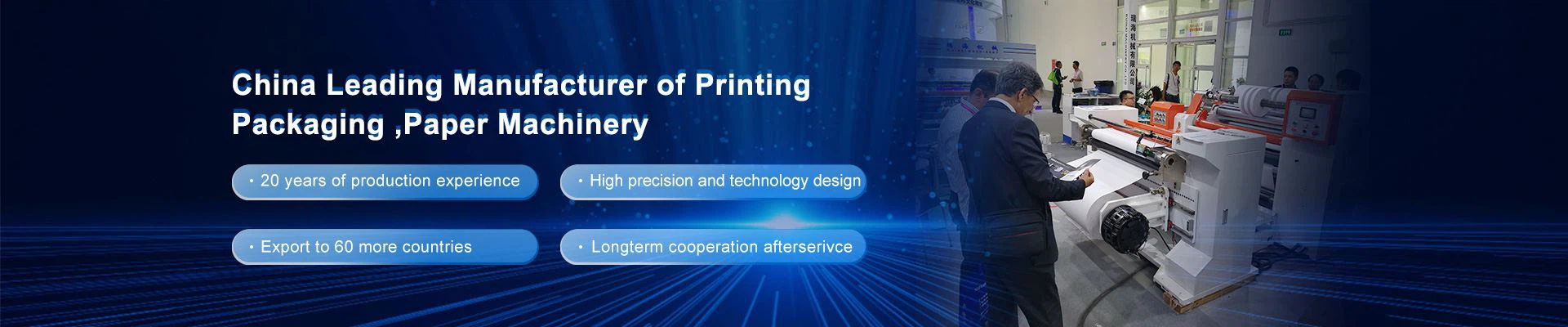
In today's diverse industrial landscape, Rewinding Machineoperate like a silently yet crucial cog in a vast array of industries. From paper products, ubiquitous in our daily lives, to film materials essential for packaging, rewinders play an irreplaceable role. Their unique functionality and high efficiency have made them an essential component of modern industrial production processes. So, what exactly are rewinders used for? Let's delve deeper.

Rewinder Applications
Paper Industry
In paper mills, newly manufactured large rolls of paper are often unable to reach the market directly. To address this issue, mechanical processing is often employed. Large rolls are cut into smaller products, which then undergo a series of processing steps to produce the finished product. Rewinders are capable of rewinding these large rolls into smaller rolls of varying diameters and widths according to predefined standards. These rewinders typically utilize mechanical devices to accomplish this task. For example, in the production of toilet paper, rewinders can rewind large, wide rolls of toilet paper into smaller rolls suitable for household use, making it more convenient for consumers to purchase and use the paper. Rewinders are also crucial equipment in papermaking plants. They not only provide a pleasant working environment for workers but also improve paper quality. Rewinders also adjust the tension of paper. Because paper has a certain degree of elasticity, it will relax or tighten after rewinding. The degree of this tension depends on the tension the paper is subjected to. If the paper is rolled too tightly, there is a high risk of breakage during use; if it is rolled too loosely, packaging costs will be excessive. If it is rolled too loosely, transportation and storage will be adversely affected. Therefore, the rewound paper must maintain a certain tension to ensure smooth winding. By precisely controlling the rewinder, we can ensure optimal tension, thereby safeguarding paper quality and user experience.
Film Industry
Rewinders also play an indispensable role in the production of plastic film. Rewinders are critical equipment in film production lines. For example, for food packaging film, large rolls of film must be processed through a rewinder to convert them into smaller rolls suitable for packaging machines. Rewinders not only ensure excellent physical and mechanical properties for films but also effectively reduce production costs. Furthermore, during the rewinding process, rewinders are capable of precisely inspecting and adjusting the film's surface quality. Therefore, rewinder performance is crucial in the production of film for food packaging. For example, they can eliminate surface defects and wrinkles, ensuring film flatness and transparency, thereby enhancing the quality and appearance of food packaging.
Other Industries
Besides the paper and film industries, rewinders are also widely used in other industries, such as metal foil and nonwovens. As a crucial piece of equipment, rewinders are widely used in a variety of applications, including metal foil, nonwovens, plastics, and leather. In the metal foil manufacturing process, rewinders are capable of rewinding large sheets of foil into smaller sizes, facilitating subsequent handling and application. With the development of the metal foil market, the use of rewinders is becoming increasingly widespread. In the production of nonwovens, rewinders are capable of cutting and rewinding nonwovens to meet the specific specifications of various products.
How does a rewinder process paper or film?
Basic Structure
The main components of a rewinder include the unwinder, traction unit, rewinder, and winder. The unwinder and traction units are the most important. The unwinder can be considered a "material storage room," ensuring that raw materials are steadily released from large rolls of paper or film, providing the necessary base materials for subsequent processing. The unwinder acts as a small storage container, storing large quantities of materials of varying specifications, such as paper, plastic, and metal, and keeping them organized. The traction unit can be considered a precise "speed controller," utilizing a motor and drive system to control the speed of material movement, ensuring that materials enter the rewinder at a steady rate. The rewinder is one of the most critical and complex components of a rewinder, practically the heart of the entire machine. A malfunction can severely impact the entire production system. The rewinder is a key component of the rewinder. Like a skilled craftsman, it precisely rewinds the various materials fed from the unwinder according to pre-set procedures. The tension control system acts as a "traction force regulator," adjusting the distance between the rewind roller and the paper web according to the required tension, ensuring the rewinder maintains the appropriate tension during operation. The winder, which can be considered a "finished product storage box," neatly stores the rewound materials for subsequent handling and storage.
Description of Each Device
When the unwinder begins operating, it secures the large roll of material to a designated shaft based on specific production needs. The tension control system ensures stable material tension to prevent loosening or breakage during the unwinding process. To achieve these functions, the unwinder is typically driven by a hydraulic system. The traction device precisely controls the material's movement rate by adjusting the motor's rotational speed and transmission ratio. The take-up device cools, shapes, and rewinds the unwound material to ensure proper use. During rewinding, it's crucial to ensure that the material enters the rewinding equipment at a steady rate. Failure to do so could result in uneven rewinding, negatively impacting product quality. Therefore, ensuring that the rewinding equipment meets performance requirements and ensures rewinding quality is crucial during initial design. A rewinding device typically consists of multiple rollers, between which the material undergoes multiple winding and extrusion processes to form the desired roll structure. Because the tension changes as the rollers rotate, it also varies during rewinding, maintaining a consistent material thickness and improving product yield. During rewinding, the rewinding device can also cut various materials as needed, narrowing wider materials to meet various production requirements. To ensure product quality and efficiency, a sound rewinding strategy must be in place before rewinding to avoid problems such as wrinkles. When the rewinding device receives the rewound material, it uses a motor to compactly wind the material onto the reel. The rewinding device is one of the key components for continuous material conveying and automatic zeroing. The rewinding equipment is also responsible for controlling tension during the rewinding process to ensure that the finished roll is tight and neat.
Rewinding Process Parameter Adjustment
During the rewinding process, tension management and speed matching are two critical variables. They have a direct impact on the final product, with tension control being the most important. Improper tension management can cause material stretching, deformation, or wrinkling, among other undesirable effects. For example, when rewinding paper, if the tension is set too high, the paper may stretch, becoming thinner, negatively impacting its overall strength and quality. If the tension is too low, the paper may wrinkle, negatively impacting its smoothness during rewinding. Therefore, the rewinding process is a complex and critical step, primarily ensuring that the finished product has a uniform thickness and meets various dimensional requirements. Speed matching is crucial: the speeds of the unwinding, take-up, and rewinding devices must be consistent. Otherwise, material accumulation or stretching may occur, impacting production continuity and product quality. Furthermore, factors such as the relationship between different paper thicknesses and between different paper types and different types of equipment must be considered to influence the rewinder's performance. By fine-tuning these parameters, the rewinder can ensure high-quality paper or film processing, thereby producing products that meet standard requirements.

The main differences between rewinders and conventional winding equipment are:
Functionality
Rewinders not only perform basic winding functions but also perform various operations such as slitting and tension adjustment. Slitting is the most important basic function of a rewinder. For example, a paper rewinder can cut large rolls of paper into narrow rolls of varying widths to meet various needs. It can also precisely adjust the tension of the paper to ensure smoother handling during subsequent use. Rewinders are generally categorized into two types: standard and precision. Compared to other types of winding equipment, standard rewinders simply roll up the material and lack key functions such as slitting and tension adjustment.
Precision
Rewinders must meet higher precision standards in key areas such as winding diameter and tension control. Rigorous inspection of the dimensions provided by the rewinder is essential during operation, as it effectively ensures consistent product quality. Regarding winding diameter, rewinders can precisely control the finished roll diameter according to specific product specifications, keeping tolerances within a very narrow range. Furthermore, to effectively measure and adjust paper roll dimensions, rewinders feature a user-friendly interface and enable remote monitoring via the internet. For example, when manufacturing toilet paper rolls of specific sizes, rewinders can ensure that each roll meets the specified diameter standard, thus ensuring consistent product appearance and quality. Furthermore, rewinders can automatically and evenly wind rolls of varying thickness onto the reel by adjusting the roller speed, achieving a superior finished product. Regarding tension control, rewinders utilize cutting-edge sensors and control systems to monitor and adjust material tension in real time, ensuring it remains optimal. Furthermore, the rewinder's high precision ensures operational stability. However, traditional winding equipment lacks precision and cannot meet the high-quality production standards required.
Applications
Rewinders are particularly suitable for industries with high material quality requirements and complex production processes. With the continuous development of society and economy, people's living standards are gradually improving, and higher standards are being put forward for product quality, which makes rewinding technology a very important process technology. As mentioned earlier, in the fields of paper, film and metal foil, these industries have strict standards for product specifications, quality and appearance, so high-precision and multi-purpose tools such as rewinders are needed to meet production needs. Rewinders can be divided into two types: ordinary winding and special winding. Ordinary winding equipment is mainly used in situations where material quality requirements are not strict and the production process is relatively simple, such as simple cable winding and preliminary winding of cloth.

Advantages of Rewinders in Improving Production Efficiency
High Degree of Automation
Modern rewinders are equipped with cutting-edge automated control systems, enabling multiple functions such as automatic loading and roll changing. Automatic loading is the core of the rewinder, directly impacting product quality and the smooth execution of subsequent processes. During automated loading, the rewinder utilizes tools such as robotic arms or conveyor belts to automatically transfer large amounts of raw material to the unwinding equipment, significantly reducing the time and workload associated with manual handling. Furthermore, impurities and substandard products can be promptly removed from the raw material to prevent contamination of the finished product. Automatic roll changing technology allows the rewinder to automatically disconnect the material after a roll is fully rewound, install a new core, and then continue rewinding. This eliminates the need for manual intervention and significantly improves production continuity. Therefore, rewinders have become an indispensable component of modern paper production lines. For example, after introducing a highly automated rewinder, one paper mill not only saw an increase in production efficiency of over 30% but also successfully reduced labor costs.
High-Speed and Stable Operation
The rewinder utilizes a high-efficiency motor and drive system, enabling stable operation at relatively high speeds. It primarily consists of a motor, drive mechanism, frame, tension roller, and control system. Its characteristics include high speed, high torque, high precision, high efficiency, compact size, light weight, and the ability to achieve high-speed winding. Each component of the rewinder undergoes meticulous design and optimization to ensure exceptional stability and reliability during high-speed operation. The rewinder generates minimal heat during operation and eliminates any frictional losses, thereby reducing energy consumption. For example, some cutting-edge rewinders can operate at speeds of hundreds of meters per minute, significantly reducing manufacturing cycle times and increasing output per unit time. Furthermore, due to their simple structure, ease of operation, and low maintenance costs, rewinders are widely used. Compared to traditional winding equipment, rewinders demonstrate significant advantages in large-scale production due to their high-speed and stable performance.
High Quality Stability
Through precise control of various rewinder parameters, such as tension, speed, and winding diameter, we ensure consistent product quality. After rewinding, the finished product undergoes cooling, trimming, and packaging processes to reach the final product. Each of these processes interacts and constrains each other. During the manufacturing process, the rewinder's sensors and control system track and adjust this data in real time to ensure that each product meets quality requirements. The performance of the rewinder directly impacts the appearance and quality of printed products. Product quality consistency helps reduce defective rates and lower overall production costs. Therefore, the rewinder is a crucial piece of equipment in the printing industry, and its operating status directly impacts the quality of printed products. Furthermore, excellent product quality consistency can effectively enhance a company's market competitiveness, earning high customer trust and positive reputation.
Conclusion
In summary, rewinders play a broad and critical role in industrial manufacturing. With the advancement of modern science and technology, rewinders have evolved from their initial simple use for producing single-size products to increasingly complex, multi-product, and multifunctional applications. These machines are capable of finely processing a wide range of materials, such as paper and film. Through the collaboration of various devices, they achieve high-quality rewinding, cutting, and tension adjustment. Furthermore, because rewinders offer multiple functions, including automatic winding, tension control, and web-correction positioning, they can effectively address product quality issues caused by manual errors during actual production. Compared to conventional winding equipment, rewinders demonstrate significant advantages in multiple areas, including functionality, precision, and application. In the packaging sector in particular, rewinders are widely used in areas such as carton printing, corrugated cardboard manufacturing, and food processing. Furthermore, rewinders, with their high degree of automation, fast and stable operation, and excellent quality consistency, play a crucial role in improving production efficiency. Furthermore, rewinders can also provide companies with significant cost savings. With modern industrial production increasingly prioritizing efficiency and quality, rewinders have become an indispensable core equipment across multiple industries, and their importance will only grow with industrial progress.


